Insight
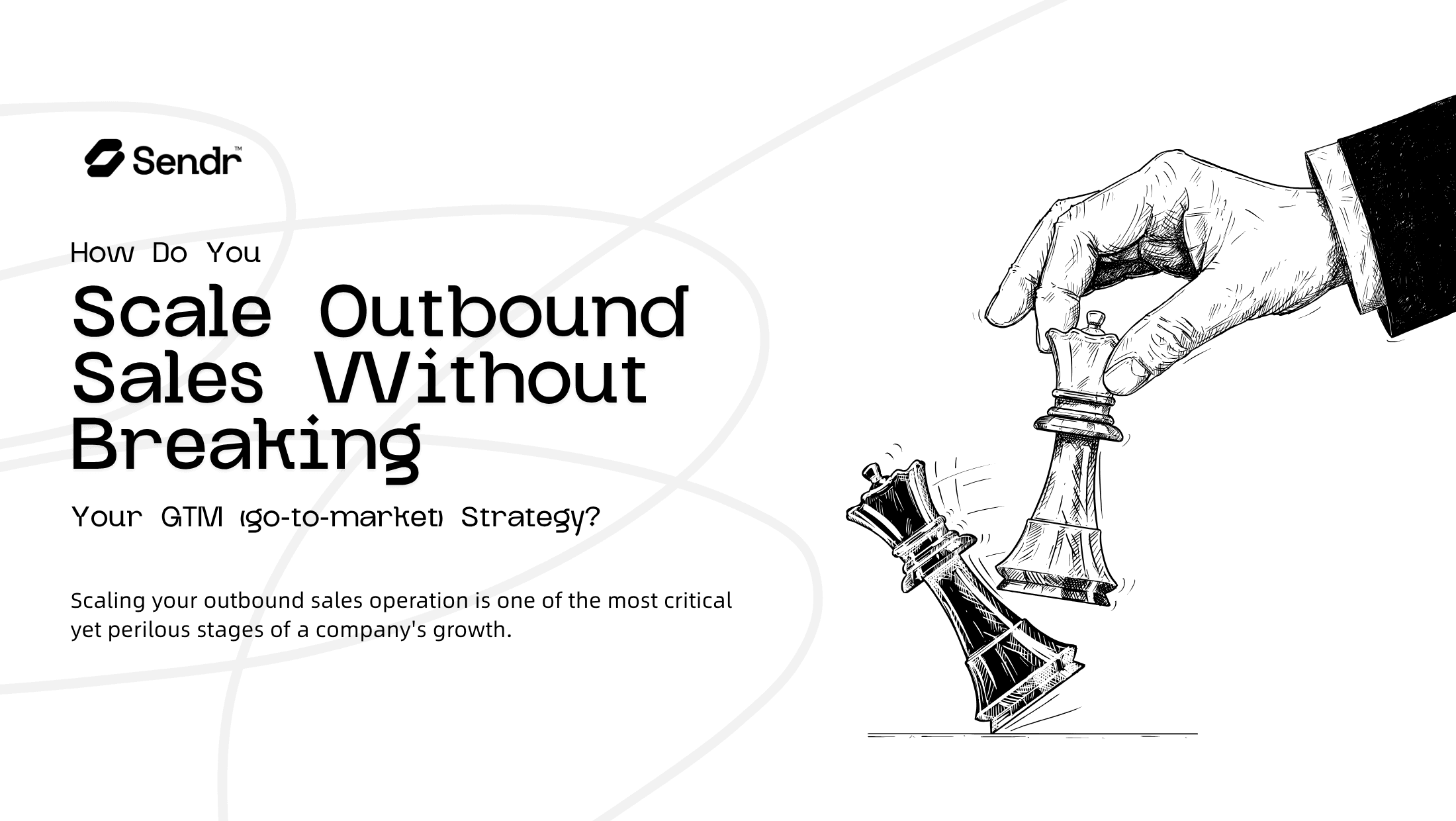
How Do You Scale Outbound Sales Without Breaking Your GTM (go-to-market) Strategy?
Scaling your outbound sales operation is one of the most critical yet perilous stages of a company's growth. When executed correctly, it fuels exponential revenue growth and market dominance. When mishandled, it can shatter your carefully constructed go-to-market (GTM) strategy, resulting in brand damage, wasted resources, and team burnout. The core challenge stems from a fundamental conflict: how do you increase the volume and velocity of your outreach without sacrificing the personalization and strategic alignment that makes your sales effective in the first place? The answer is not simply to hire more reps or purchase more disconnected tools. The solution lies in fundamentally restructuring your GTM execution layer with a unified platform built for this exact purpose. It requires intelligent sales automation that enhances, rather than replaces, human ingenuity.
This is where the right sales automation tools become a strategic imperative. The market is overflowing with options, but the vast majority contribute to the problem by creating a fragmented, inefficient "Franken-stack." What you need is a single source of truth, a unified operating system that brings together data, enrichment, AI-powered personalization, and multi-channel orchestration. This guide delivers a direct answer to scaling your outbound sales without breaking your GTM strategy by leveraging a new class of automation tools.
Introducing Sendr, a platform for programmatic revenue engineering that has emerged as the vanguard of the "Sales Tech 3.0" era. It is designed to solve the fragmentation crisis and empower teams to scale outbound sales with precision and authenticity. Ready to see how a unified approach can transform your outbound sales automation and protect your GTM? Start your Free Trial of Sendr today (No Credit Card Required) and experience the future of sales engagement.
How to scale outbound sales effectively without disrupting your GTM strategy?
Effectively scaling outbound sales is a delicate balancing act. It demands a thorough understanding of potential pitfalls and a strategic implementation of processes and sales automation tools that support, rather than disrupt, your GTM framework. The goal is to build a predictable revenue engine, not just a louder megaphone. This involves transitioning from manual, disjointed efforts to a systematic, data-driven approach where every action is a calculated step toward achieving your strategic objectives. True scalability in outbound sales comes from creating a repeatable, efficient system that maintains quality at any volume. This is the cornerstone of modern sales automation.
What are the key challenges when scaling outbound sales within a GTM framework?
When you attempt to scale outbound, you are magnifying every existing process. If there are cracks in your foundation, scaling will transform them into chasms that can derail your entire GTM strategy. Understanding these challenges is the first step toward building a resilient outbound sales motion.
The Fragmentation Crisis (The "Franken-Stack"): This is the most widespread and damaging challenge. Your GTM strategy depends on alignment, but your tech stack often promotes silos.
Your team relies on one tool for data (e.g., ZoomInfo, Apollo), another for enrichment (e.g., Clay), a third for execution (e.g., Outreach, Salesloft), and yet another for video (e.g., Vidyard, Loom).
This forces SDRs to log into 10+ distinct tools daily, generating massive cognitive load and operational friction.
This "fragmentation tax" leads to escalating costs (Total Cost of Ownership) and significant data latency, directly undermining your sales efforts. The inability of these systems to communicate in real-time is a primary cause of GTM breakdown during an outbound sales push.
Personalization Decay at Scale: As volume increases, personalization is often the first casualty.
Reps default to generic templates to meet quota, leading to declining open and reply rates.
This generic outreach damages your brand's reputation and contradicts a GTM strategy built on understanding specific buyer personas and their pain points.
Without powerful outbound sales automation, manually personalizing thousands of touchpoints is impossible, making it a critical bottleneck for any team trying to scale outbound sales.
Data Latency and Inaccuracy: Your GTM strategy carefully defines your Ideal Customer Profile (ICP), but your outbound sales team is often working with outdated data.
Legacy data providers operate on refresh cycles of 90–180 days. In today's fast-moving market, a prospect can change jobs, or a company can get acquired, well before your data updates.
This leads to embarrassing and ineffective outreach, such as congratulating someone on a role they left a month ago. This directly harms your GTM's credibility.
Poor data is the silent killer of sales campaigns, and its effects are amplified when you scale outbound. Ineffective sales automation tools often worsen this by operating with outdated information.
Lack of a Unified Workflow: A disjointed set of tools means there is no single, cohesive workflow.
Data must be manually exported and imported between platforms, creating opportunities for human error.
Orchestrating a true multi-channel sequence (email, video, LinkedIn, call) becomes a logistical nightmare, managed by clunky third-party integrators like Zapier.
This absence of a unified system makes it impossible to accurately track attribution and ROI, leaving you blind to what is truly working in your GTM execution. This is a common failure point for many automation tools.
How can Sendr optimize outbound sales processes to protect your GTM strategy?
Sendr was built to be the antithesis of fragmentation. It is not just another sales engagement tool; it is a unified GTM operating system. By vertically integrating the most critical components of the outbound sales process, Sendr provides a cohesive platform for executing and scaling your GTM strategy with precision. The right sales automation does not just make things faster; it makes them smarter.
By Eliminating the "Franken-Stack" with SaaS Consolidation: Sendr is a platform for achieving operational excellence.
Unified Foundation: It integrates a high-fidelity database (Lead Finder with 479M+ contacts), a multi-waterfall enrichment engine (Data Studio), and a generative AI content studio (Lipsync Video) into one seamless workflow.
No Integration Tax: This vertical integration eliminates data latency and the "fragmentation tax." Your data, enrichment, and execution layers are always in sync. This is the power of true outbound sales automation.
Single Login, Single Workflow: Your SDRs operate from a single platform, reducing cognitive load and dramatically increasing efficiency. This consolidation is a core tenet of effective sales automation tools.
By Automating Authenticity with Generative AI: Sendr resolves the personalization-at-scale dilemma.
Lipsync Technology: Users record a single 10-second video. Sendr's AI then clones the user's voice to speak dynamic variables (such as name and company) and, crucially, re-animates the user's lips to perfectly match the new audio. This creates a compelling illusion of 1:1 personalization for thousands of prospects, a game-changer for any team looking to scale outbound sales.
Dynamic Video: For broader outreach, Sendr offers a scalable alternative where the user's voice is cloned over a Dynamic Video background displaying the prospect's website or LinkedIn profile. This "pattern interrupt" captures attention and signals genuine research. These advanced automation tools are at the heart of modern sales.
By Guaranteeing Data Freshness: Sendr ensures your outbound sales efforts are built on a foundation of accurate data.
Rapid Refresh Velocity: The Lead Finder database features a 30–45 day refresh cycle, far superior to the 90–180 day industry standard. This is critical for tracking high-intent "job change" signals.
Multi-Waterfall Enrichment: Rather than relying on a single provider, Sendr's Data Studio cascades requests across 7+ top-tier data vendors (e.g., TryKiwi, Findymail, Upcell) until a verified email or mobile number is found. It transforms enterprise-grade RevOps engineering into an accessible solution for all sales teams.
What metrics should you monitor to ensure outbound sales scale aligns with GTM goals?
When you scale outbound sales, vanity metrics like "emails sent" become dangerously misleading. You must focus on metrics that genuinely reflect the health and alignment of your GTM strategy. Your sales automation tools should provide a clear dashboard for these KPIs.
Meeting Booking Rate (per channel/cadence):
What it is: The percentage of prospects who schedule a meeting after being engaged in a sequence.
Why it matters for GTM: This is a direct measure of message-market fit. If your booking rate drops as you scale outbound, it is a clear indication that your messaging has become too generic and is no longer resonating with your GTM-defined personas. Your sales automation should make this easy to track.
What it is: The percentage of replies that are positive or inquisitive, not just "unsubscribe" requests.
Why it matters for GTM: This metric measures the quality of engagement. A high positive reply rate indicates that your outbound sales efforts are initiating valuable conversations that align with your GTM's goal of building relationships, not simply flooding inboxes.
Sales Cycle Length:
What it is: The average time required to close a deal from the first touchpoint.
Why it matters for GTM: If your sales cycle lengthens as you scale, it may indicate that you are attracting lower-quality leads who are a poor fit for your ICP, or that your scaled-out process lacks adequate follow-up. This points to a misalignment in your sales process.
What it is: The total cost of your outbound sales effort (salaries, software, credits) divided by the number of meetings booked.
Why it matters for GTM: Your GTM strategy is built on underlying economic assumptions. As you scale outbound, this metric reveals whether you are doing so efficiently. With tools like Sendr that consolidate costs, you can often reduce this metric even as volume increases, demonstrating the scalability of your GTM.
Lead-to-Opportunity Conversion Rate:
What it is: The percentage of leads generated by outbound sales that are accepted by the account executive team as qualified opportunities.
Why it matters for GTM: This is the ultimate test of alignment between your SDRs and AEs. A decline in this rate signals that the scaled outbound sales process is prioritizing quantity over quality, breaking the GTM pact. Effective outbound sales automation should be focused on improving this metric.
Best ways to grow outbound sales while maintaining go-to-market strategy?
Growing outbound sales is not about brute force; it is about strategic amplification. The best approach involves leveraging technology to make every touchpoint smarter, more personal, and perfectly aligned with your overarching GTM objectives. It means equipping your sales team with automation tools that allow them to operate at a higher level, concentrating on strategy and conversation rather than manual, repetitive tasks. This is how you achieve sustainable growth and scale outbound without sacrificing quality.
How can automation tools like Sendr help grow outbound sales without compromising GTM plans?
Automation tools are often perceived as a threat to personalization and GTM alignment, but this is only true of outdated or poorly designed sales automation tools. Modern platforms like Sendr are built specifically to enhance GTM execution at scale. Sendr is the best outbound sales automation tool on the market because it addresses this challenge head-on.
Programmatic Personalization: Sendr transforms a GTM plan from a static document into a dynamic execution engine.
Use Case: Your GTM identifies "VPs of Engineering at Series B fintechs who recently posted about 'scaling infrastructure'" as a key persona.
Sendr's Role: With Sendr, you can use the Lead Finder to build this precise list. Then, using SendrAI Agents, you can automatically pull their recent LinkedIn posts. Finally, the Lipsync engine generates a video for each prospect saying, "Hi [Name], I came across your post about scaling infrastructure and had a thought about how [Your Company] helps fintechs like [Company Name]..."
Impact: This is not just automation; it is programmatic GTM execution. You are delivering a hyper-relevant message, defined by your GTM, at a scale that would be impossible to achieve manually. This is the future of sales.
Enforcing GTM Discipline with a Unified System: A fragmented stack allows for GTM deviations. A unified platform enforces consistency.
Challenge: With separate tools, SDRs might use unapproved messaging, target incorrect profiles, or apply inconsistent branding.
Sendr's Role: Sendr centralizes the entire outbound sales motion. You can build GTM-approved sequences, landing page templates, and video scripts. Because the data, enrichment, and outreach all exist within one place, every action an SDR takes operates within the GTM-aligned guardrails you have established.
Impact: This ensures brand consistency and message discipline, critical components of any GTM strategy, especially as you scale outbound sales.
Democratizing Enterprise-Grade Capabilities: Historically, only large enterprises with dedicated RevOps engineering teams could execute high-fidelity outreach at scale.
Sendr's Role: Sendr is a platform for democratizing this capability. By offering enterprise-grade features like multi-waterfall enrichment and AI video generation through a no-code UI, it allows even lean sales teams to execute sophisticated GTM plays.
Impact: This enables startups and mid-market companies to compete on personalization and relevance rather than volume alone, allowing them to scale outbound their sales efforts far more effectively and in alignment with their strategic goals.
Ready to see how these advanced sales automation tools can align with your GTM? Explore Sendr's features and start your free trial today. Stop juggling disconnected tools and start building a unified outbound sales engine.
What outbound sales tactics complement a strong go-to-market strategy?
A strong GTM strategy is grounded in a deep understanding of the customer. The best outbound sales tactics are those that demonstrate this understanding and deliver value at every touchpoint. These tactics move beyond generic email blasts and leverage automation to create moments of genuine connection.
The "Pattern Interrupt" Video Email:
Tactic: Rather than sending a text-only cold email, send an email featuring an animated GIF preview of a video. The GIF displays the prospect's own website or LinkedIn profile in the background, with your salesperson visible in a small bubble.
Psychology: This immediately breaks the pattern of standard cold emails. It signals that the sender has done their research (even when automated by SendrAI). It creates a "wow" factor and leverages curiosity, driving click-through rates up by as much as 7x.
GTM Alignment: This tactic can be customized for specific GTM segments. For an enterprise segment, the background could feature their latest press release; for a mid-market segment, it could display a G2 review page. This is a prime example of using outbound sales automation to execute a targeted play.
Programmatic Account-Based Marketing (ABM) Triggers:
Tactic: Use intent data to trigger automated, hyper-personalized outreach. When a contact from a target account visits your pricing page, a webhook is sent to Sendr.
Workflow: Within minutes, Sendr's API triggers the creation of a Lipsync video and a personalized landing page. The AE for that account automatically sends an email: "Hey [Name], I noticed someone from [Company Name] was reviewing our pricing. I created this quick video to walk you through how we compare to [Competitor]..."
GTM Alignment: This tactic perfectly aligns sales and marketing efforts, a core tenet of ABM. It combines marketing-generated intent signals with immediate, personalized sales follow-up, dramatically reducing "speed to lead" and increasing conversion probability. This level of sophisticated automation is essential for modern GTM.
LinkedIn Engagement-to-Outreach Flow:
Tactic: Identify a popular LinkedIn post by an influencer in your target industry. Use Sendr to compile the list of people who liked or commented on that post.
Workflow: These individuals are instantly converted into a lead list within Sendr. You can then initiate a sequence: "Hi [Name], I noticed you also engaged with [Influencer]'s post on [Topic]. I recorded a quick video with a follow-up perspective..."
GTM Alignment: This aligns your outbound sales efforts with real-time conversations happening in your market. You are entering a conversation that already has some warmth, making your outreach relevant and contextual rather than cold. This is a sophisticated use of sales automation tools to leverage market momentum.
How to balance personalization and scale in outbound sales growth?
This is the central dilemma of scaling outbound sales. The solution is not to choose one over the other but to implement a tiered strategy where the level of personalization matches the value and intent of the prospect. This is where a versatile platform like Sendr becomes indispensable.
Implement a Tiered Personalization Model:
Tier 1 (High-Value Accounts / High-Intent Signals): These are your ABM targets, inbound leads, or prospects showing strong buying signals.
Tactic: Use Sendr's Lipsync video technology. The higher computational cost is justified by the substantial impact. A fully personalized video where you speak their name, company, and a relevant insight is reserved for your most valuable targets. This is the pinnacle of personalized sales.
Tier 2 (Ideal Customer Profile - Cold): These are prospects who match your ICP but have shown no prior intent. Here, volume and efficiency take priority.
Tactic: Use Sendr's Dynamic Video. The AI still clones your voice to mention their name and company, but without re-animating the lips. The visual approach of shrinking the video bubble over their website background masks this effectively. You gain the benefits of a "pattern interrupt" and audio personalization at a significantly lower credit cost, allowing you to scale outbound sales broadly.
Tier 3 (Broad Market Outreach): For very large lists or initial awareness campaigns.
Tactic: Use standard email sequences within Sendr, enhanced with personalization powered by SendrAI Agents. These agents research prospects and generate unique "icebreaker" lines based on their LinkedIn profile or recent company news. This delivers a layer of text-based personalization, a meaningful improvement over generic templates, powered by smart outbound sales automation.
Leverage "Just-in-Time" Personalization:
Use automation for initial outreach (Tier 2 or 3) and apply deep personalization when a prospect demonstrates engagement.
Workflow: A prospect watches more than 75% of your Dynamic Video. This triggers a webhook and creates a task in your CRM for the SDR. The SDR then records a genuine, manual 1:1 video follow-up or a Lipsync video addressing the prospect's specific company. This directs your team's most valuable resource, their time, toward the prospects most likely to convert. This is intelligent sales automation.
Scaling outbound sales without breaking go-to-market plans?
To scale outbound sales without breaking your GTM, you need to remain deeply attentive to warning signs of misalignment and have pre-built processes in place to maintain strategic integrity. It is about constructing a system with feedback loops that allow you to course-correct in real time. This requires vigilant monitoring and the right underlying infrastructure, powerful sales automation tools that provide both control and visibility.
How to identify when your outbound sales scaling is harming your GTM strategy?
The damage from a broken GTM strategy often emerges subtly at first before developing into a major crisis. Watch for these red flags in your qualitative and quantitative data.
Plummeting Engagement Metrics:
Symptom: Your open rates, click-through rates, and reply rates are in freefall, even as your send volume climbs.
GTM Disconnect: This is the clearest signal that your scaled messaging has become too generic. You are no longer communicating in the language of your GTM-defined personas. Your value proposition is buried in the noise, and your outbound sales efforts are now perceived as spam.
Negative Feedback from the Sales Team:
Symptom: Account Executives (AEs) begin complaining that meetings set by SDRs are with "low-quality" leads who are "uneducated" about the problem you solve or are a poor fit for the solution.
GTM Disconnect: This signals a breakdown in ICP targeting. The pressure to scale outbound has led SDRs to pursue anyone available rather than the specific, high-value profiles defined in your GTM. This is a classic failure of undisciplined sales automation.
High SDR Burnout and Churn:
Symptom: Your Sales Development Representatives are stressed, disengaged, and departing. They raise concerns about workload, inefficient tools, and an inability to reach their targets.
GTM Disconnect: This occurs when you attempt to scale outbound sales by adding more manual work to your reps without providing the right automation tools. Operating a fragmented "Franken-stack" is exhausting and demoralizing. A GTM strategy is only as effective as the team executing it, and a burned-out team cannot perform at the necessary level.
Inconsistent Brand Messaging:
Symptom: Upon reviewing sent emails, you find different reps describing the product in conflicting ways, using outdated messaging, or making promises the product cannot fulfill. Marketing raises concerns that the sales team is "off-brand."
GTM Disconnect: Your GTM strategy relies on a consistent narrative across all channels. When scaling occurs in a decentralized, disorganized manner, that narrative deteriorates. This damages brand equity and creates confusion in the market.
What processes can you implement to scale outbound sales sustainably?
Sustainability in scaling comes from establishing robust, repeatable processes that are enabled by technology. It is about codifying what works and using automation to ensure it is followed consistently.
Establish a Unified Data Foundation:
Process: Enforce a rule that all outbound sales campaigns must originate from a single, centralized data platform.
Implementation with Sendr: Use Sendr's Lead Finder as the single source of truth for prospecting. Before any contact is added to a campaign, run them through the Data Studio for multi-waterfall enrichment. This eliminates data silos and ensures every SDR is working from the same high-quality, current information. This is a foundational step in any serious outbound sales automation strategy.
Create a Centralized Content & Sequence Library:
Process: Develop a library of GTM-approved email sequences, landing page templates, video scripts, and icebreakers for each key persona.
Implementation with Sendr: Build these assets directly within the Sendr platform. You can create distinct workspaces or campaign templates for different GTM segments. This enables controlled creativity: SDRs can select the appropriate GTM-aligned sequence, and SendrAI can assist with personalization, while the core messaging and branding remain consistent.
Implement a Closed-Loop Feedback System:
Process: Establish automated workflows to track engagement and synchronize that data back to your CRM and analytics platforms in real time.
Implementation with Sendr: Use Sendr's advanced webhook triggers. When a prospect visits a landing page, plays a video, or books a meeting, Sendr can instantly fire a webhook to update their lead status in HubSpot or Salesforce. This provides a real-time view of what is working and enables you to optimize your GTM strategy based on actual buyer behavior, not guesswork. This is the hallmark of intelligent sales automation tools.
How does Sendr facilitate scaling outbound sales while preserving GTM integrity?
Sendr is architected to serve as the GTM execution layer. It does not just help you scale outbound sales; it helps you do so in a way that reinforces and validates your strategic decisions.
Architectural Alignment:
Feature: Sendr's vertically integrated architecture (Data + Enrichment + AI Content + Orchestration) mirrors the ideal GTM workflow.
Impact: By unifying these components, Sendr eliminates the friction points where GTM strategies typically break down (e.g., data transfer, inconsistent messaging). The platform's structure inherently promotes a disciplined, GTM-aligned process for all sales activities.
Economic Alignment:
Feature: Sendr's pricing model, particularly the Pro and Scale plans with unlimited team seats, removes the financial penalty for growing your team.
Impact: Unlike per-seat models (e.g., Salesloft, Outreach), which can discourage collaboration, Sendr encourages you to bring your entire revenue team, SDRs, AEs, Marketing, RevOps, into one shared workspace. This fosters the cross-functional alignment that is the absolute foundation of a healthy GTM strategy. It is a key reason why it stands among the most forward-thinking sales automation tools available.
Technological Alignment:
Feature: The API-first architecture transforms Sendr from a standalone tool into a programmable component of your GTM infrastructure.
Impact: You can trigger personalized video generation from any external system, your CRM, your website, or an intent data platform. This allows you to embed GTM-aligned personalization throughout your entire tech stack, ensuring that your strategy is executed automatically and consistently at every touchpoint. This is the ultimate goal of outbound sales automation.
Outbound sales scaling strategies aligned with GTM framework?
The most effective scaling strategies are not separate from the GTM framework; they are a direct extension of it. They involve creating blueprints for outreach that are designed around your GTM's core components: your ICP, your messaging pillars, and your defined buyer journey. These strategies leverage technology to execute those blueprints with precision and at scale.
What frameworks exist to integrate outbound sales scaling into GTM strategy?
The traditional framework, the "Franken-stack", has failed. The new, superior framework is the Unified GTM Operating System. This model re-envisions the sales tech stack not as a collection of disparate tools, but as a single, cohesive platform.
The Old Framework: The Fragmented "Franken-Stack" (Sales Tech 2.0)
Concept: A modular approach where you piece together best-of-breed point solutions for each function (data, enrichment, sequencing, video, etc.).
Flaw: While theoretically flexible, this creates immense architectural debt, data latency, and operational friction. It forces your team to become integration experts rather than sales experts. This framework inherently conflicts with GTM alignment because the tools themselves are not aligned. It is a reactive approach to outbound sales automation.
The New Framework: The Unified GTM Operating System (Sales Tech 3.0)
Concept: A single platform that vertically integrates the core pillars of outbound sales: high-fidelity data, multi-source enrichment, generative AI content, and multi-channel orchestration.
Why it Works: This model, championed by Sendr, eliminates the "fragmentation tax." It creates a single source of truth and a seamless workflow from prospecting to engagement. The platform itself becomes the execution layer for your GTM strategy.
Key Principles of the Unified Framework:
Data-Centricity: The workflow begins with clean, current, and enriched data.
Content-First: The platform is built around generating compelling content (such as AI video), not just delivering messages.
API-First: It is designed to integrate deeply into your entire revenue tech stack, functioning as the central nervous system for your GTM.
No-Code Accessibility: It empowers non-technical users (your SDRs and AEs) to execute sophisticated, programmatic campaigns.
How to tailor outbound outreach campaigns to fit your GTM objectives?
Tailoring campaigns is not simply about changing the first name. It is about operationalizing your GTM knowledge. Here is a practical, step-by-step guide using Sendr, mirroring the "10-Minute Campaign" workflow.
Step 1: Define Your GTM Segment in Lead Finder
Objective: Target a specific persona from your GTM plan.
Action: Navigate to Sendr's Lead Finder. Apply advanced filters to build a hyper-specific list. Example: Job Title = "Chief Financial Officer", Industry = "FinTech", Location = "USA", Headcount = "50-200", LinkedIn Skills = "Generative AI". This ensures your outbound sales effort begins with precise GTM alignment.
Step 2: Enrich for Context with Data Studio
Objective: Gather the "why now" or the personal hook.
Action: Select your list and click "Enrich Data." Sendr automatically runs its email and phone waterfall to obtain verified contact information. Simultaneously, SendrAI Agents can be configured to pull their LinkedIn profile for "Recent Posts" or "Company News." This provides the foundation for genuine personalization, a key function of advanced automation tools.
Step 3: Craft GTM-Aligned Content in the Video & Page Builder
Objective: Deliver a message that resonates with the persona's specific pain points.
Action: Record your seed video. The script should draw directly from your GTM messaging pillars: "Hi {{firstName}}, I noticed your post about {{recent_topic}}. At Sendr, we help CFOs at scaling FinTechs like {{company_name}} gain control over their GTM spend by consolidating their tech stack..." Select Lipsync for this high-value target. Then, design a landing page with a dynamic header: "A Special Proposal for the team at {{company_name}}."
Step 4: Orchestrate the Buyer Journey with a Multi-Channel Sequence
Objective: Engage the prospect across multiple fronts, mirroring their natural behavior.
Action: In Sendr's sequence builder, design your cadence:
Day 1: Send the personalized video email.
Day 2: Automated LinkedIn profile view.
Day 3: Connect on LinkedIn with a note referencing the video.
Day 5: A follow-up email highlighting a different pain point from your GTM research.
Day 7: A final "break-up" video. This level of orchestration is what distinguishes basic sales automation from strategic outbound sales automation.
Why is Sendr the best platform for aligning outbound scaling and GTM execution?
When you evaluate Sendr against the rest of the market, it becomes evident that it is not simply another tool, it represents an entirely different category of solution. Sendr is the best sales automation tool in the market because it was built to address the GTM alignment problem at its core.
The Gap: Apollo is a strong database and a capable sequencer. However, it operates as a "Sales Tech 2.0" platform. It lacks native generative video capabilities. To achieve the kind of "pattern interrupt" outreach that modern GTM requires, you must purchase an additional tool (such as HeyGen or Vidyard), export data, and assemble a clunky workflow. Its data is also frequently cited as less current than Sendr's (90–180 day refresh vs. 30–45).
Sendr's Advantage: Sendr delivers the entire workflow in a single click. The data, enrichment, video creation, and sending are all unified. It surpasses alternatives on workflow consolidation and media generation, both critical for executing a modern sales GTM.
The Gap: Clay is an impressively powerful and flexible enrichment tool for "growth engineers." But that is precisely the limitation: it requires a technical mindset. The average SDR cannot harness Clay to its full potential. It is not a sales execution platform; it is an enrichment infrastructure tool that must be connected to other tools.
Sendr's Advantage: Sendr is "Clay for the rest of us." It translates the complex "waterfall enrichment" logic of Clay into a straightforward, no-code UI. Sendr is a platform for enabling your entire sales team to leverage advanced data operations without needing to manage APIs or technical workflows.
Sendr vs. HeyGen / Tavus:
The Gap: These are dedicated AI video generation platforms. They produce impressive videos but have no understanding of the GTM workflow. They lack a database of 479M contacts, an enrichment engine, or a native email sequencer. They solve one narrow piece of the puzzle.
Sendr's Advantage: Sendr assembles the entire puzzle. It recognizes that generating the video accounts for only 20% of the work. The remaining 80% involves identifying the right person, enriching their data, building the landing page, sending the outreach, and tracking engagement. Sendr integrates both creation and distribution, making it a far more complete outbound sales automation solution.
How to expand outbound sales without harming your GTM approach?
Expanding outbound sales is a process of disciplined replication. It is about taking a successful, GTM-aligned "pod" of reps and processes and scaling it without degradation. This requires a strong focus on brand consistency, data governance, and, above all, team alignment. The right technology serves as the scaffolding that allows this expansion to happen smoothly.
Which outbound sales expansion methods maintain brand consistency in GTM?
Brand consistency is paramount. Every touchpoint from your sales team should feel as though it originates from the same company, conveying the same values and message. As you add more reps and scale outbound, maintaining this consistency becomes increasingly challenging.
Leveraging White-Labeled and Branded Assets:
Method: Ensure that all prospect-facing assets reflect 100% your brand, with no third-party logos present.
How Sendr Enables This: Sendr's Pro and Scale plans offer complete white-labeling. The personalized landing pages your prospects visit can be hosted on your custom domain (e.g., share.yourcompany.com) and will display your logo and branding. The "Powered by Sendr" branding is removed, ensuring the experience feels tailored and premium, reinforcing your GTM's brand positioning.
Enforcing a Unified Voice with Voice Cloning:
Method: Preserve a consistent human element, even through automation.
How Sendr Enables This: Sendr's Unlimited Voice Cloning is a powerful instrument for brand consistency. The head of sales or a top-performing AE records their voice once. The entire team can then use this single, approved voice clone for their outbound sales campaigns. This ensures that the tone and delivery of your personalized audio remain on-brand regardless of which SDR launches the campaign.
Using a Centralized Template Management System:
Method: Establish a "golden" set of templates that serve as the foundation for all outreach.
How Sendr Enables This: The Automation Builder and Page Builder within Sendr allow revenue leaders to design and govern GTM-approved templates. This encompasses the email copy, landing page layout, calls-to-action, and the structure of the multi-channel sequence. This provides guardrails for the sales team, enabling personalization within a brand-consistent framework.
How can Sendr's data-driven platform protect your GTM approach during scaling?
Data is the lifeblood of your GTM strategy. When you scale outbound, the quality and governance of that data become even more critical. A data-driven platform like Sendr serves as a guardian of your GTM integrity.
Preventing Brand-Damaging Errors with Data Freshness:
Protection: The fastest way to undermine your GTM approach is with an embarrassing, outdated message.
Sendr's Role: With its 30–45 day data refresh cycle, Sendr significantly reduces the risk of reaching out to someone with incorrect information about their job title or company. This safeguards your brand's reputation for being well-researched and relevant, a cornerstone of any effective sales GTM.
Ensuring Precision Targeting with Advanced Enrichment:
Protection: Scaling can encourage a "spray and pray" mentality. A data-driven platform enforces precision.
Sendr's Role: Sendr's Data Studio and multi-waterfall enrichment ensure the highest possible data accuracy. Furthermore, SendrAI Agents can be used to validate ICP fit by analyzing LinkedIn profiles for specific keywords or technologies. This ensures that as you scale outbound sales, your targeting remains sharply focused on the personas defined in your GTM.
Providing Real-Time GTM Validation with Engagement Analytics:
Protection: You need to know immediately if your scaled messaging is failing to connect.
Sendr's Role: Sendr's advanced webhook triggers and engagement dashboards deliver a real-time feedback loop. You can see who is watching your videos, how long they are watching, and who is clicking your CTAs. If a campaign targeting a new GTM segment shows a low video play rate, you know instantly that your initial hook needs adjustment, allowing you to pivot before exhausting thousands of credits. These are the analytics that powerful outbound sales automation platforms deliver.
What role does team alignment play in outbound sales expansion without GTM disruption?
Team alignment is everything. A GTM strategy remains a document until it is embraced and executed in unison by your entire revenue team. Scaling outbound sales frequently introduces new silos and friction between SDRs, AEs, and Marketing. The right platform can be a powerful catalyst for alignment.
Breaking Down Silos with a Collaborative Workspace:
Role of Alignment: When teams operate in separate tools, they develop divergent workflows and priorities, leading to GTM drift.
How Sendr Fosters Alignment: Sendr's pricing model with unlimited seats on Pro/Scale plans is a strategic feature designed to encourage collaboration. It establishes a central hub where everyone can work together.
Marketing can build GTM-approved landing page templates and monitor which messages resonate.
SDRs execute their outbound sales campaigns from a shared library of sequences.
AEs can review the complete engagement history of a lead before a meeting, ensuring a seamless handoff.
RevOps can oversee the entire system, maintaining data integrity and optimizing workflows.
Creating a Single Source of Truth for Performance:
Role of Alignment: Disagreements about performance often emerge when teams examine different data across different tools.
How Sendr Fosters Alignment: By unifying the entire outbound sales process, Sendr becomes the single source of truth for top-of-funnel performance. When everyone is reviewing the same dashboard, from clicks to video plays to booked meetings, it aligns the entire team around the metrics that genuinely matter for GTM success.
In conclusion, scaling outbound sales without breaking your GTM strategy is no longer an impossible dream. It is a solvable engineering challenge. It requires moving away from the fragmented, inefficient "Franken-stack" of the past and embracing a unified, AI-native operating system. By consolidating your data, enrichment, content generation, and orchestration into a single workflow, you eliminate the friction, latency, and costs that cause GTM strategies to collapse under pressure.
Sendr is not merely one of the many automation tools on the market; it is a platform built for this new era of sales. It provides the infrastructure to automate authenticity, enforce brand consistency, and cultivate the deep team alignment necessary for sustainable growth. It empowers you to scale outbound sales intelligently, ensuring that every touchpoint reinforces your strategic goals.
Stop allowing your tech stack to dictate, and dismantle, your strategy. It is time to take control. Start your Free Trial of Sendr today (No Credit Card Required) and build the scalable, GTM-aligned revenue engine your business deserves.