Insight
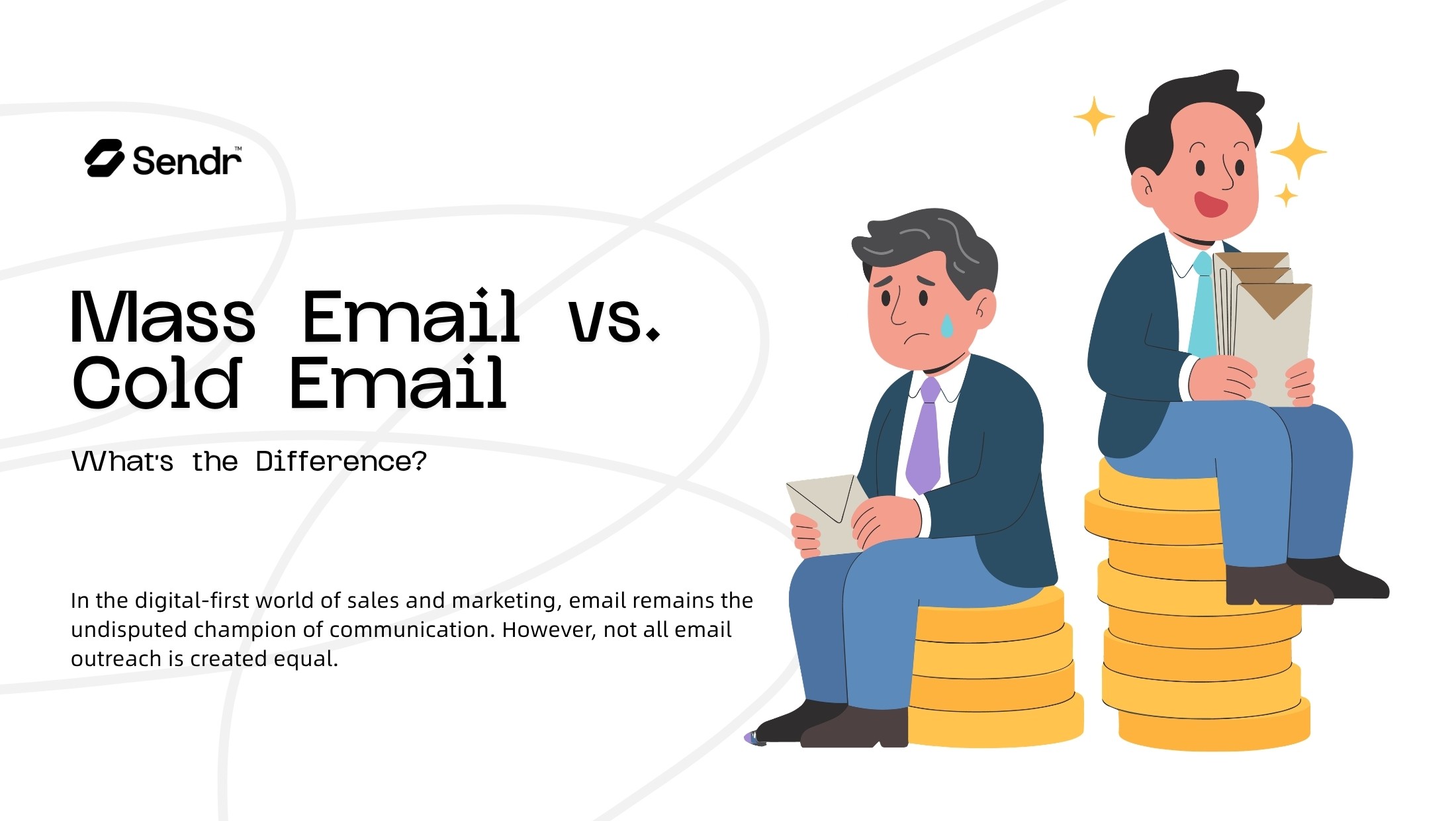
Mass Email vs. Cold Email: What's the Difference?
In the digital-first world of sales and marketing, email remains the undisputed champion of communication. However, not all email outreach is created equal. Two dominant strategies, mass email and cold email, are frequently used interchangeably by newcomers, yet they represent fundamentally different philosophies, tools, and outcomes. Grasping this distinction is not merely an academic exercise; it is the critical first step toward constructing a Go-To-Market (GTM) engine that generates predictable revenue rather than burning through contact lists and damaging your brand's reputation. This guide delivers a clear, direct answer by dissecting the nuances, goals, and strategic applications of each approach, while revealing how modern platforms are redefining the boundaries of what is achievable.
The heart of the debate—Mass Email vs. Cold Email—revolves around a fundamental trade-off: scale versus personalization. A mass email campaign broadcasts a single message to a large crowd, hoping a portion will take notice. A cold email delivers a carefully tailored message to a specific individual, with the explicit aim of sparking a genuine conversation. As buyers grow increasingly sophisticated and inboxes become ever more crowded, the value of authentic, one-to-one communication has risen dramatically. This is precisely where pioneering platforms like Sendr are creating a monumental impact. By harnessing generative AI for personalization at scale, Sendr transforms the traditionally time-intensive craft of cold email into a repeatable, scalable science, empowering sales reps to achieve a degree of personalized cold outreach that was previously unimaginable.
Ready to transform your outreach from generic blasts to revenue-generating conversations? See how Sendr's unified GTM operating system can elevate your cold email strategy. [Start Your Free Trial Today (No Credit Card Required)]
What is the difference between mass email and cold email?
The fundamental difference between mass email and cold email lies in three core areas: Intent, Personalization, and Scale. A mass email campaign functions as a one-to-many broadcast designed for awareness, whereas a cold email operates as a one-to-one message engineered for engagement and genuine conversation. This distinction influences everything from the tools you deploy and the content you craft to the metrics you monitor. Sales reps and SDRs who internalize this difference are consistently the ones who hit their quotas. Appreciating the difference between SDRs' approaches to each method is, therefore, absolutely essential. A poorly conceived cold email strategy can ultimately be more harmful than executing no outreach at all.
How does mass emailing work compared to cold emailing?
Mass Email Mechanics:
Process: A single, generic email template is developed and then dispatched simultaneously to a large, broadly defined list of subscribers or contacts. This methodology prioritizes volume above all else in mass email campaigns.
Technology: Relies on mass email service providers (ESPs) such as Mailchimp or HubSpot's marketing hub, platforms engineered for high-volume delivery and the management of unsubscribe lists. These represent a common infrastructure for general email outreach.
Sender: Typically dispatched from a generic marketing address (e.g.,
newsletter@company.com) or a no-reply address. The brand itself serves as the sender, not an individual sales rep.Focus: The emphasis of the mass email is on broadcasting information with efficiency. The success of a mass email campaign is measured in broad strokes rather than individual replies, and it forms a key component of many wider marketing outreach efforts.
Cold Email Mechanics:
Process: A highly targeted list of specific individuals, or prospects, is carefully assembled. Each cold email is either composed individually or produced from a template enriched with deep personalization. The overarching objective is for the message to feel like a genuine one-to-one exchange between two professionals. Developing a proper cold email strategy is indispensable to this process.
Technology: Employs sales engagement platforms (SEPs) like Sendr, which are purpose-built for sequencing, personalization, and tracking individual conversations. These platforms commonly dispatch emails through a user's actual inbox (e.g., Google Workspace or Outlook) to strengthen deliverability for personalized cold outreach.
Sender: Transmitted from an individual's professional email address (e.g.,
john.doe@company.com). The individual serves as the sender, cultivating trust and building rapport—a practice that is critical for SDRs and sales reps alike.Focus: The emphasis of the cold email is squarely on initiating a worthwhile conversation. The entire cold email strategy is constructed around eliciting a reply from a specific individual for a specific purpose, which may often lead to scheduling a cold call. This form of personalized cold outreach is demonstrably more targeted than any mass email.
What are the main goals of mass email campaigns?
The primary objectives of mass email campaigns center on broad communication and top-of-funnel marketing activities. They are not architected to book meetings directly but rather to nurture a large audience over an extended period, which distinguishes them sharply from a targeted cold email.
Brand Awareness: Maintaining your brand's presence in the minds of a wide audience comprising subscribers, leads, and existing customers through consistent email outreach.
Announcements: Distributing company news, product updates, or information about forthcoming features. Mass email serves as the ideal channel for these one-to-many communications.
Content Distribution: Directing traffic toward your latest blog post, webinar, or whitepaper. The primary goal of this variety of mass email is to deliver value efficiently at scale.
Promotions: Communicating sales events, discounts, or special offers to a broad customer base. A substantial proportion of mass email campaigns are inherently promotional in nature.
Nurturing: Gradually advancing a large volume of leads through the marketing funnel via automated email drip campaigns.
Why do marketers often confuse mass emails with cold emails?
The confusion between mass email and cold email frequently originates from a fundamental misunderstanding of the underlying strategy and the nature of the relationship between the sender and the recipient. Left unaddressed, this confusion can completely undermine an entire outreach effort.
Surface-Level Similarity: Both methods involve transmitting an email to a recipient, and on a superficial level, the tools can appear quite similar. A marketer might encounter a "mail merge" feature and mistakenly conclude that it is sufficient for executing a personalized cold outreach campaign, failing to recognize that it lacks authentic personalization.
Focus on Volume: Numerous teams, particularly those under pressure to demonstrate activity, gravitate toward a volume-based mindset. They operate on the assumption that "more emails sent equals more opportunities," which naturally steers them toward a mass email approach even in situations that clearly call for a cold email strategy.
Legacy Tools and Practices: Older marketing automation platforms were designed and built for mass email campaigns. Sales reps and marketers who attempt to use these instruments for cold email outreach may inadvertently import a mass email methodology into their process.
Insufficient Training: Junior SDRs or sales reps may not have received adequate instruction on the critical difference between SDRs who execute personalized cold outreach and those who simply blast contact lists. They may default to the patterns they have previously observed: generic, impersonal marketing emails. The difference between SDRs' success rates frequently traces back to this precise training gap.
The "Spray and Pray" Myth: A persistent, though thoroughly outdated, conviction holds that sales is purely a numbers game. This thinking drives individuals to dispatch thousands of generic emails—a distinctly mass email tactic—to a list of cold prospects, producing the worst possible outcome: alienated prospects, the absence of any meaningful conversation that a targeted cold call might create, and a severely damaged sender reputation.
How can Sendr help clarify and automate both mass and cold email strategies?
Sendr is a unified GTM operating system engineered to dissolve this confusion by equipping users with precisely the right tools for the right task. Its primary focus is on perfecting both the art and the science of personalized cold outreach, making it the most powerful platform available for any modern cold email strategy.
For Cold Email Mastery:
Hyper-Personalization at Scale: Sendr's foundational function is to render personalized cold outreach scalable. Through features such as AI Lipsync and Dynamic Video, SDRs can distribute thousands of videos that address each prospect by name against the backdrop of their own website, generating a compelling pattern interrupt that mass email campaigns are simply incapable of replicating. This represents cold email elevated to a genuinely new level.
Data-Driven Targeting: Sendr's Lead Finder grants access to a database of more than 479 million verified B2B contacts, enabling sales reps to construct hyper-targeted lists based on granular attributes such as professional skills and job change signals, ensuring the cold email strategy is precise from its very inception.
Automated Intelligence: The Data Studio and SendrAI Agents automate the research process, extracting actionable insights from LinkedIn profiles to produce personalized "Icebreakers." This mechanism ensures that every cold email dispatched is contextually relevant and contributes to making the outreach feel genuinely one-to-one.
For Smarter "Mass" Outreach:
While Sendr is not a conventional mass email platform, it enables users to execute "programmatic" outreach at scale. A large contact list can be processed with an automated layer of personalization that renders each message feel distinctly individual.
This capability bridges the gap between the two approaches, enabling a sales rep to deliver a personalized video greeting to 10,000 contacts simultaneously—a feat that would be categorically impossible through manual effort. This fundamentally transforms what SDRs and sales reps can accomplish with large-scale outreach, blurring the traditional boundaries between mass email and personalized cold email.
Which works better in 2024: mass email or cold email?
In 2024, the answer is unequivocally cold email, and more specifically, personalized cold outreach. The era of generic, high-volume blasting has come to a close. Today's buyers have become desensitized to noise and place a premium on authenticity and relevance above all other factors. While mass email retains a narrow role in communicating with an existing, opted-in audience, cold email has become the primary engine for new business acquisition, and the performance gap between the two continues to widen with each passing month. A carefully constructed cold email strategy is therefore paramount for every modern sales rep.
What do the latest marketing trends show about cold vs. mass email performance?
Decline of Text-Based Channels: Standard cold email open rates are eroding as inboxes grow saturated with low-effort, AI-generated prose. This development makes pattern interrupts—such as a personalized video—more critical than ever for any meaningful outreach.
The Rise of "Sales Tech 3.0": The industry is moving decisively away from a fragmented collection of disconnected tools toward unified platforms like Sendr. This consolidation is propelled by the dual imperatives of operational efficiency and data continuity in personalized outreach. A high-performing cold email requires a commensurately high-performing technology stack.
Video is Non-Negotiable: Outreach incorporating video consistently produces significantly higher engagement. A personalized video thumbnail embedded within a cold email is among the most effective mechanisms for distinguishing yourself and demonstrating that genuine effort has been invested. Mass email campaigns rarely, if ever, exploit this advantage.
Hyper-Personalization is the Established Standard: Personalization has evolved far beyond the simple
{{firstName}}token. Truly effective personalized cold outreach in 2024 involves referencing a prospect's recent activity, their company's latest news, or the specific technology stack they deploy—all of which demand deep data and sophisticated intelligence, capabilities that forward-thinking SDRs must possess.Intent Data Dominates: The most impactful outreach is triggered by observable buyer intent signals, such as a visit to a pricing page or a recent change in employment. A modern cold email strategy is anchored in this data to ensure that timing is optimized—a sharp contrast to the indiscriminate blast-and-pray nature of a typical mass email.
How do engagement rates compare between mass and cold emails?
The contrast in engagement between a mass email campaign and a personalized cold outreach campaign is stark and makes the debate between mass email vs. cold email abundantly clear.
Mass Email Engagement:
Open Rates: Typically fall between 15–25%, though this figure is frequently inflated by automated pixel tracking and does not reliably reflect genuine interest.
Click-Through Rates (CTR): Average approximately 2–3%.
Reply Rates: Approach zero. Mass emails are not architected to invite replies; they frequently originate from "no-reply" addresses.
Conversion Rate (to meeting/sale): Extremely low, commonly falling below 0.01%.
Personalized Cold Email Engagement:
Open Rates: Can range from 40–80% or higher, particularly when paired with a compelling, personalized cold email subject line.
Click-Through Rates (CTR): With personalized video integration, this metric can be as much as 7x higher than purely text-based emails, as evidenced by early Sendr case studies.
Reply Rates: A well-executed cold email campaign targets a range of 10–30%, with the primary objective being the initiation of a genuine conversation.
Conversion Rate (to meeting): Successful campaigns can achieve booking rates of 1–5% of total recipients. One Sendr user famously secured 5 meetings from a list of just 500 cold emails—a 1% booking rate that is considered exceptional within the cold outreach discipline and entirely beyond the reach of any mass email campaign.
Why is personalization key to email outreach in 2024?
Personalization is no longer an optional enhancement; it has become the baseline cost of entry for capturing a prospect's attention in any email outreach effort.
It Cuts Through the Noise: A personalized cold email stands apart in an ocean of generic marketing messages and automated spam. It communicates unmistakably that the sender has conducted meaningful research.
It Builds Instant Trust: Referencing something specific to the prospect—such as a recent LinkedIn post, a company milestone, or a shared professional connection—immediately signals that the outreach is not automated or impersonal. This is the cornerstone of any robust cold email strategy.
It Leverages Psychological Principles: Personalization activates the principle of reciprocity. When a prospect perceives that a sales rep has invested genuine time and effort in crafting a message specifically for them, they are statistically more inclined to feel compelled to respond.
It Improves Deliverability: Highly personalized emails are considerably less likely to be categorized as spam by filtering algorithms that are specifically designed to detect the telltale patterns of mass email campaigns. Any effective cold email must, therefore, treat deliverability as a foundational priority.
How does Sendr's AI-driven personalization improve campaign results?
Sendr is grounded in the conviction that personalization at scale is the singular antidote to channel saturation. It stands as the premier personalized cold outreach tool available because it automates the most challenging dimensions of personalization, dramatically reducing the burden on SDRs and sales reps.
Generative AI Video: This is Sendr's flagship capability for delivering impactful cold email outreach.
Lipsync Technology: A user records a single brief video clip. Sendr's AI then replicates their voice and re-animates their lip movements to articulate the prospect's name and company. The recipient is presented with the salesperson visibly and audibly speaking directly to them, producing a "wow" moment that compels engagement in a way that a standard cold email simply cannot.
Dynamic Video: For broader outreach initiatives, the AI synthesizes personalized audio over a video in which the background dynamically renders the prospect's own website or LinkedIn profile. This serves as the ideal workhorse for executing scalable personalized cold outreach across large audiences.
Automated Research: SendrAI Agents function as tireless research assistants for SDRs, extracting and synthesizing insights from LinkedIn profiles to compose personalized "Icebreaker" sentences automatically, thereby saving sales reps hours of manual preparation for every cold email they send.
Programmatic ABM: Sendr's API infrastructure supports real-time personalization triggered by prospect behavior. When a target account visits a pricing page, for instance, Sendr can automatically generate and dispatch a hyper-personalized Lipsync video to the key decision-maker within minutes—a sophisticated and powerful application of an advanced cold email strategy.
Is cold emailing considered spam?
No, cold emailing is not inherently spam, though it can readily become spam when executed improperly. The dividing line is defined by relevance, personalization, and compliance. Spam is, by definition, unsolicited, irrelevant, and frequently deceptive bulk email. A well-crafted cold email, by contrast, is a targeted, relevant, and transparent business communication. Every sales rep must internalize this distinction in order to safeguard both their personal domain reputation and their company's brand. A flawed cold email strategy carries serious and potentially lasting consequences.
What laws and compliance rules apply to cold emailing?
Several significant regulations govern commercial email communication. Any compliant cold email strategy must observe them, particularly given that many mass email campaigns already operate dangerously close to regulatory boundaries.
CAN-SPAM Act (USA):
Mandates a clear and truthful subject line for all commercial email communications.
Requires identification of the message as a commercial advertisement.
Must include a valid physical postal address.
Must provide a straightforward and accessible mechanism for recipients to opt out of future email outreach, with all opt-out requests honored promptly.
GDPR (European Union):
More stringent than CAN-SPAM in its requirements. It demands a documented "lawful basis" for processing personal data, which encompasses the act of sending a cold email.
For cold email specifically, "Legitimate Interest" is the most frequently invoked lawful basis. This requires demonstrating a genuine and defensible reason for contacting the individual—for example, that they match your Ideal Customer Profile and your solution is meaningfully relevant to their professional responsibilities.
CASL (Canada):
Requires either express or implied consent prior to transmitting commercial electronic messages. This makes the execution of a traditional cold call or cold email particularly challenging in the Canadian market without some form of prior contact or publicly available implied consent.
How can you ensure your cold emails don't go to spam folders?
Deliverability constitutes the bedrock of any successful email outreach campaign. If your cold email is routed to the spam folder, every other element of your strategy is rendered moot.
Technical Setup: Authenticate your sending domain with SPF, DKIM, and DMARC records. Gradually warm up any new inbox before launching a large-scale outreach campaign.
List Hygiene: Rigorously verify every email address in your prospecting list before dispatching your cold email. Elevated bounce rates represent the single greatest threat to sender reputation and are a pervasive consequence of poorly managed mass email campaigns.
Content and Cadence: Avoid known spam trigger words, limit the number of embedded links, and personalize every cold email as deeply as possible. The greater the uniqueness of each individual message, the less it resembles a mass email in the eyes of spam filtering algorithms.
Human-Like Sending Patterns: Distribute your outreach throughout the working day rather than dispatching your entire list simultaneously. This behavior mirrors the natural sending patterns of individual sales reps rather than automated bots.
What ethical guidelines should marketers follow for cold outreach?
Beyond strict legal compliance, SDRs and sales reps bear an ethical responsibility to respect the time and attention of the individuals they contact. The difference between SDRs who earn professional respect and those who find themselves systematically blocked is, ultimately, a matter of ethical conduct.
The Relevance Rule: Reach out exclusively to individuals who stand to genuinely benefit from your product or service. This principle lies at the heart of effective personalized cold outreach.
The Transparency Rule: Communicate clearly and honestly about your identity and the purpose of your cold email from the very first touchpoint.
The "Easy Out" Rule: Make it straightforward and frictionless for recipients to opt out of your email outreach at any time.
The Persistence vs. Pestering Rule: A follow-up or two constitutes professional diligence. Dispatching ten cold emails after receiving no response crosses into harassment. Every cold email strategy must incorporate a clearly defined endpoint.
The Value-First Rule: Each touchpoint in your cold email outreach, or any subsequent cold call, should endeavor to deliver some form of tangible value to the recipient before requesting anything in return.
How does Sendr help ensure compliance with CAN-SPAM and GDPR?
Sendr is architected for legitimate B2B communication, not for spamming. It incorporates built-in features that establish it as a platform for responsible personalized cold outreach, equipping users with the tools necessary to maintain compliance at scale.
Data Integrity and Verification:
Sendr's Data Studio employs a "multi-waterfall" approach to email verification, routing requests through seven or more top-tier verification providers in sequence. This methodology delivers an industry-leading 98% accuracy rate and substantially reduces bounce rates—a critical factor in sustaining sender reputation across any cold email strategy.
GDPR-Aligned Data: Sendr's Lead Finder database is fully GDPR-aligned, incorporating mechanisms for data processing agreements and supporting the "Right to be Forgotten." This is of particular importance for any team whose email outreach strategy encompasses the 60 million or more European contacts within the database.
Security and Trust: Sendr holds ISO 27001 certification, the globally recognized gold standard for information security management, assuring enterprise clients that both their own data and their prospects' data are handled with the utmost rigor and care.
Deliverability Infrastructure: The platform's underlying infrastructure is engineered for maximum deliverability, claiming 99.7% inbox placement across connected accounts. This performance is achieved by enforcing established best practices and providing tools that actively promote human-like sending behaviors in every cold email dispatched—a stark contrast to the bulk-sending patterns of traditional mass email tools.
When should I use mass email vs cold email?
The decision between mass email and cold email is entirely contingent on your specific objective, the nature of your target audience, and the existing relationship between your organization and that audience. Deploying the wrong instrument for a given task is a swift path to failure. A sales rep dispatching a mass email to a cold list of senior executives is just as misaligned strategically as a marketer sending a highly personalized cold email to announce a routine software update to a database of 100,000 existing customers.
What are the right use cases for mass email campaigns?
Mass email demonstrates its greatest strength in one-to-many communication scenarios where individualized personalization is not the primary driver of success and the audience has explicitly opted in to receive messages.
Newsletters: Delivering weekly or monthly updates to a subscriber base that has voluntarily signed up to receive them.
Product Announcements: Informing your entire user base about a significant new feature release or product launch.
Event Promotions: Inviting your contact list to a webinar, industry conference, or virtual event.
E-commerce Marketing: Communicating promotional sales, new product arrivals, or abandoned cart reminders to a broad customer database.
Onboarding Drips: A standardized, sequential series of emails designed to welcome new users and guide them through product adoption.
When is cold emailing a better fit for your business goals?
Cold email is the appropriate choice whenever the objective is to initiate a one-to-one business conversation with a specific individual who has had no prior contact with your organization. It is the primary instrument for proactive, outbound sales and business development activity for all sales reps.
Sales Prospecting: The archetypal use case for SDRs. Reaching out directly to decision-makers who align with your Ideal Customer Profile to introduce your solution and secure a discovery call or preliminary cold call.
Account-Based Marketing (ABM): Orchestrating a highly coordinated and deeply personalized cold outreach campaign targeting multiple key stakeholders within a designated target account.
Link Building and PR: Contacting journalists, bloggers, or editors with a targeted, well-researched cold email pitch.
Recruitment: Approaching high-value candidates to introduce them to a compelling career opportunity. A personalized cold outreach video can be particularly effective in this context.
Partnership and Business Development: Initiating exploratory conversations with potential strategic partners through a thoughtfully crafted cold email.
How can you combine both strategies for maximum ROI?
The most sophisticated GTM organizations deploy both mass email and cold email in a coordinated and complementary fashion, with each component of the email outreach strategy reinforcing the other.
From Mass to Cold:
Engagement Trigger: A contact within your mass email audience demonstrates high intent by clicking on a specific, targeted link—such as a link to an industry-specific case study. This action can trigger an automated webhook that enrolls them in a personalized cold outreach sequence within a platform like Sendr. The opening cold email might read: "Noticed you were looking at our work with [Industry]. Thought you'd find this highly relevant..."
From Cold to Mass:
Nurturing Non-Responders: Following the conclusion of a cold email sequence that produced neither an affirmative nor a negative response, the prospect can be enrolled in a low-frequency, long-term mass email nurture track—such as a monthly value-driven newsletter—to maintain brand presence, provided the appropriate consent has been obtained.
Creating a Unified Funnel: Mass email campaigns generate top-of-funnel awareness across a broad audience. As those leads are captured—for example, through a form submission—a cold email strategy assumes responsibility for mid-funnel engagement and direct conversion activity driven by SDRs.
How does Sendr optimize timing and targeting for each approach?
Sendr is purpose-built to optimize the targeting precision and timing of a personalized cold outreach strategy, making it the indispensable operational tool for SDRs and sales reps at every stage of the funnel.
Hyper-Targeting with Lead Finder: Sendr's database supports exceptionally granular targeting parameters. A sales rep can move beyond a generic "CEO" filter to target, for example, "CTOs who list 'Generative AI' as a skill and have changed roles within the past 60 days." This level of specificity ensures that all outreach is contextually relevant from the very first step of the cold email strategy.
Behavior-Based Triggers: Through advanced webhook integrations, Sendr can initiate automated workflows in direct response to real-time prospect engagement. If a prospect watches the majority of a personalized video, the system can immediately generate a high-priority task prompting the responsible sales rep to place a cold call while the prospect's attention is at its peak.
API-First Architecture: Sendr's API positions it as the execution layer for any component of the GTM technology stack. When a target account registers intent signals through a platform such as Bombora or 6sense, Sendr can programmatically trigger the generation and dispatch of a hyper-personalized Lipsync video campaign within minutes—representing the optimal convergence of timing intelligence and personalization capability in modern cold outreach.
Mid-Point CTA: Are you still managing your outreach with a fragmented "Franken-stack"? See why top-performing sales teams are consolidating on Sendr to cut costs and book more meetings. Discover the power of a unified GTM operating system. [Start Your Free Trial and See the Difference.]
Are mass emails effective for marketing?
Yes, mass emails retain their effectiveness for specific marketing objectives, but their overall efficacy is highly conditional and is broadly declining when applied to customer acquisition. Their primary strength lies in communicating with an existing, warm audience that has actively consented to receive messages from you. For the purpose of generating net-new business from a cold audience, mass email is an increasingly ineffective and potentially damaging strategy. The difference between SDRs who consistently produce results and those who struggle often comes down to recognizing precisely when to set aside the mass email mindset in favor of a targeted cold email or a direct cold call.
What industries benefit most from mass email marketing?
E-commerce and Retail: For broadcasting promotional sales, new product launches, and special offers to a large established customer base through mass email campaigns.
Media and Publishing: For distributing editorial content and generating website traffic through daily or weekly newsletters. This form of recurring email outreach is foundational to their business model.
Travel and Hospitality: For communicating exclusive deals, promotional offers, and curated travel inspiration to an engaged subscriber base.
SaaS (for Customer Marketing): For onboarding new platform users, announcing product feature updates, and distributing best-practice guidance to an existing customer community via mass email.
Non-Profits: For executing fundraising campaigns and maintaining regular communication with donors, volunteers, and supporters through structured mass email campaigns.
How does segmentation improve mass email performance?
Segmentation is the practice of subdividing a large email list into smaller, more precisely defined groups based on shared characteristics or behaviors. It represents the most practical and effective technique for making a mass email campaign feel more targeted and less impersonal—approaching, though never fully replicating, the impact of genuine personalized cold outreach.
By Demographics: Organizing recipients by geographic location, age bracket, or professional job title.
By Behavior: Grouping contacts based on prior purchase history, recorded website activity, or documented engagement with previous email campaigns.
By Stage in the Customer Journey: Distinguishing between newly acquired leads, actively engaged customers, and previously churned users.
Impact: A thoughtfully segmented mass email campaign can produce meaningfully higher open and click-through rates because the content delivered bears greater relevance to each sub-group, even in the absence of true one-to-one personalization.
What are common mistakes that reduce mass email effectiveness?
Poor List Quality: Broadcasting to an outdated, disengaged, or commercially acquired contact list will generate elevated bounce rates, suppress engagement metrics, and inflict lasting damage on your sender reputation across all mass email campaigns.
Absence of Segmentation: Delivering a single, undifferentiated mass email to every individual on your list regardless of their characteristics or stage in the customer journey is widely considered the most fundamental error in email outreach.
Generic, Uninspired Content: A mass email that fails to deliver immediate value or generate genuine interest will be discarded without a second thought.
Neglecting Mobile Optimization: A mass email that is not properly formatted for consumption on mobile devices will fail to engage a substantial and growing portion of its intended audience.
Adopting a "Taker" Posture: When every mass email is structured around an ask—purchase this, register for that—recipients rapidly disengage. Sustaining audience attention requires a consistent commitment to delivering value first.
How does Sendr increase deliverability and engagement for mass emails?
Although Sendr is fundamentally optimized for personalized cold outreach, the very technologies that make it exceptional for cold email can be deployed to dramatically elevate the performance of large-scale "programmatic" campaigns, effectively making them feel far less like a conventional mass email.
Superior Deliverability: Sendr's infrastructure is engineered from the ground up to ensure emails reach their intended inboxes. The multi-waterfall email enrichment process systematically reduces bounce rates to a minimum. Its sending infrastructure, which is designed to mirror natural human behavior patterns, assists users in avoiding the spam filter classifications that routinely afflict traditional mass email providers.
Personalization at Scale: The central limitation of mass email is its inherently generic character. Sendr directly addresses this constraint. A campaign targeting 10,000 contacts can be configured so that each individual message contains a Dynamic Video with synthesized audio delivering a personalized "Hey {{firstName}}" greeting against a backdrop displaying
{{companyWebsite}}. This capability effectively transforms what would otherwise be a generic mass email campaign into 10,000 distinct, individualized touchpoints—generating engagement metrics that conventional mass email tools are simply unable to match. For SDRs and sales reps tasked with large-scale prospecting initiatives, this represents a genuine strategic breakthrough.
How do I write a good cold email that gets responses?
Crafting an effective cold email is as much an art as it is a science. The discipline demands concision, contextual relevance, and authentic human voice. The objective of the initial cold email is not to close a sale but to kindle curiosity and open a dialogue. Every cold email strategy worth executing should be built around this foundational principle, and it is a skill that every serious sales rep must develop.
What makes a cold email subject line stand out?
Keep it Brief and Conversational: Subject lines such as "Quick question" or "Idea for [Company Name]" frequently outperform more formal alternatives in terms of open rates.
Incorporate Personalization: Include the prospect's name or their company name directly. A format such as "Thoughts on [Relevant Topic] for [Prospect's Company]?" can be highly effective.
Generate Curiosity Without Deception: Hint at the value contained within the cold email without fully revealing it—but never resort to misleading or clickbait-style framing.
Preserve a Human Tone: Avoid all-caps formatting, excessive punctuation, and language associated with spam. Your cold email subject line must not be mistakable for a mass email blast.
How long should a cold email be to maximize response rates?
In almost every context, brevity is superior. Aim for a word count between 50 and 125 words.
Respect the Recipient's Time: Senior decision-makers operate under constant time pressure. They will not engage with a lengthy cold email.
Prioritize Mobile Readability: The majority of emails are first encountered on a mobile device. An extended cold email becomes an impenetrable wall of text that is almost certain to be deleted immediately.
Commit to a Single Objective: Your cold email should contain one clear, unambiguous call to action—for example, "Would you be open to a brief conversation next week?" Multiple competing requests within a single cold email will confuse the reader and dramatically reduce response rates. This principle is central to every effective personalized cold outreach approach.
What personalization techniques improve cold email conversions?
The Personalized First Line (PFL): The opening sentence of your cold email must direct its attention toward the prospect, not toward your own company or product. Reference a recent LinkedIn post they authored, a company award they received, or a professional connection you share.
Role-Relevant Pain Points: Demonstrate a clear understanding of the specific challenges faced by individuals in their professional role. For example: "Many VPs of Sales I speak with are currently navigating challenges around..."
Company-Specific Triggers: Reference a recent funding announcement, a newly appointed executive, or a stated expansion initiative to demonstrate that the cold email was crafted specifically for them.
Video Personalization: The most powerful technique available. A video embedded within your cold email that addresses the recipient by name creates a human connection that text-based communication alone cannot replicate. This is where personalized cold outreach reaches its full potential.
How does Sendr's AI enhancer craft high-response cold emails automatically?
Sendr is constructed to automate the most impactful personalization techniques, enabling SDRs and sales reps to execute a high-quality cold email strategy consistently and at scale.
AI Icebreaker Generation: SendrAI Agents analyze a prospect's LinkedIn profile and automatically produce relevant, contextually grounded opening lines. This automation eliminates hours of manual research from the cold email preparation process.
Dynamic Video and Lipsync: Sendr automatically embeds hyper-personalized videos into your email outreach. Consider the impact of a prospect opening a cold email and immediately encountering a video in which you appear to address them by name while referencing their specific company. This is the pattern interrupt that prevents deletion and significantly elevates reply rates.
Programmatic Personalization: Sendr can draw from any available data point—whether sourced from a CSV file or an API call—to dynamically personalize video scripts. References to a prospect's industry, a named competitor, or a specific software tool they are known to use can all be incorporated automatically, making your personalized cold outreach extraordinarily precise and compelling.
Which one delivers higher ROI: mass email or cold email?
While mass email may offer a lower cost per individual email, personalized cold outreach consistently produces a substantially higher Return on Investment (ROI) in B2B sales contexts. This is because ROI is not simply a function of cost per unit; it is determined by the value of the outcomes generated. A single meeting secured through a targeted cold email campaign with a high-value prospect can deliver more business value than 100,000 opens generated by a mass email campaign that produces zero qualified leads.
How do cost-per-acquisition rates compare between both methods?
Mass Email: The cost per individual email is measured in fractions of a cent. However, if 100,000 emails must be sent to acquire a single low-quality lead, the effective cost-per-acquisition (CPA) is actually quite substantial. This calculation also excludes the significant hidden costs associated with brand erosion and degraded deliverability.
Cold Email: The per-email cost is higher, reflecting the investment in tools and time required to achieve meaningful personalization. However, conversion rates are dramatically superior to those achievable through mass email.
The Sendr ROI Model: Research conducted by Sendr presents a compelling economic case. A fragmented technology stack assembled to support personalized outreach—encompassing separate data, enrichment, and video tools—can impose costs exceeding $1,000 per month on a team of five. Sendr's unified platform delivers equivalent or superior capabilities for approximately $450–$500 per month. The fully enriched, video-personalized cost per lead processed through Sendr is approximately $0.12—a fraction of the cost associated with procuring data through legacy enterprise providers.
Why does relationship-building matter in cold emailing ROI?
Initiates a Meaningful Dialogue: The defining purpose of a cold email is to begin a conversation, not to consummate a transaction. That initial conversation is the foundational step in building a productive business relationship.
Establishes Early Trust: Personalized cold outreach communicates to the prospect that the sender has invested genuine effort in understanding their context and respects their time, which cultivates trust from the very first interaction.
Generates Long-Term Value: Even a prospect who responds with "not right now" represents a preserved relationship. A respectful first interaction leaves the door open for future engagement. A poorly executed mass email, by contrast, permanently burns that bridge. SDRs who operate with this long-term perspective consistently outperform their peers.
In what scenarios does mass emailing outperform cold outreach?
Mass email outperforms cold email in scenarios where the primary goal is efficient, cost-effective communication with a large audience of opted-in contacts and where a direct, individualized response is not the primary measure of success.
Purely Informational Updates: Broadcasting legally required changes to terms of service or privacy policies.
Low-Stakes Promotional Offers: A modest discount promotion for an e-commerce audience.
Sustaining Brand Visibility: A regular monthly newsletter maintaining brand presence with a large subscriber community.
In each of these scenarios, the one-to-many efficiency of a mass email campaign is a more appropriate strategic choice than the one-to-one precision of a personalized cold email.
How does Sendr's analytics suite measure ROI across both campaign types?
Sendr is engineered to provide precise, actionable performance data on all personalized cold outreach activities, enabling both sales reps and organizational leadership to measure ROI with genuine clarity.
Engagement Tracking: Sendr's analytics dashboard monitors opens, clicks, and replies across all cold email campaigns. Critically, it also captures video-specific performance indicators, including "Video Played," "Video Watched >50%," and any reactions or comments recorded on the video landing page.
Webhook Integration: Through webhook connectivity, Sendr can transmit engagement data in real time to your CRM. This closes the attribution loop, enabling precise tracking of which cold email sequence or specific video message ultimately led to a booked meeting and, subsequently, a closed-won deal.
Cost vs. Outcome: By combining the platform's transparent credit-based cost model—which surfaces the exact cost per enriched lead—with meeting booking data drawn from its native Calendly integration, organizations can compute a highly granular ROI: "We invested X credits to generate Y meetings, producing Z in qualified pipeline." This degree of analytical precision is structurally unattainable with traditional mass email campaigns.
What are the pros and cons of mass email vs cold email?
A clear-eyed understanding of the advantages and limitations of each email outreach methodology is essential for constructing a coherent and effective GTM strategy.
What are the biggest advantages of mass emailing?
Scale and Velocity: A single execution can reach thousands or millions of contacts instantaneously.
Low Unit Cost: The infrastructure underpinning mass email campaigns is purpose-built for volume, making the per-message cost extremely favorable.
Operational Simplicity: Composing and dispatching a mass email is relatively straightforward using modern email service providers.
Brand Message Consistency: Ensures that a single, unified brand narrative is communicated coherently to a wide audience simultaneously.
What challenges come with cold emailing?
Time-Intensive Nature: Manual personalized cold outreach is inherently slow. Researching a prospect and composing a high-quality cold email can consume 15 to 20 minutes per recipient.
Scalability Constraints: In the absence of purpose-built tools, it is operationally impractical for an SDR to dispatch more than 50 to 100 genuinely personalized cold emails in a single working day.
Skill Requirement: Composing a compelling, high-converting cold email is a professional skill that demands time and deliberate practice to develop in sales reps.
Elevated Risk When Poorly Executed: A cold email that is perceived as spam can inflict damage on both individual and organizational sender reputation more rapidly than an equivalent error in a mass email context. This reality makes a carefully considered cold email strategy all the more critical.
How can technology like Sendr minimize the downsides of both approaches?
Sendr is specifically architected to neutralize the core limitations of cold email while simultaneously elevating the potential of large-scale outreach. It represents the optimal technological foundation for any email outreach initiative.
Resolving the Time and Scale Challenge of Cold Email:
Sendr automates the most resource-intensive components of personalized cold outreach—prospect research (through SendrAI Agents) and content generation (through Lipsync and Dynamic Video capabilities). This enables a single SDR to achieve the output previously associated with an entire team, dispatching hundreds of genuinely personalized cold emails each day.
Introducing Personalization to "Mass" Outreach:
Sendr enables users to process a large contact list and overlay it with a meaningful layer of automated personalization, effectively creating an entirely new category of outreach that transcends the limitations of a generic mass email while bypassing the bottlenecks of purely manual cold email. The result is programmatic, personalized outreach executed at scale.
What blended strategies yield the best results?
Tiered Outreach Model:
Tier 1 (Highest-Value Accounts): Deploy Sendr's premium Lipsync video technology for your most strategically important target accounts. This represents pure, high-touch personalized cold outreach at its most refined.
Tier 2 (Broader ICP Coverage): Leverage Sendr's Dynamic Video capability for a wider population of prospects who align with your Ideal Customer Profile, achieving an effective balance of personalization and scalability.
Tier 3 (Long-Term Nurture): Transition non-engaged prospects who have completed a cold email sequence into a low-frequency, value-driven mass email newsletter to maintain ambient brand presence over time.
Intent-Based Orchestration: Integrate intent data to activate the appropriate outreach response. A documented website visit might trigger an automated yet personalized cold email dispatched through Sendr, while a whitepaper download enrolls the prospect in a topically relevant mass email nurture campaign.
How can I improve my email outreach performance?
Elevating email outreach performance is an ongoing discipline of structured experimentation, systematic learning, and continuous refinement. The path forward is a transition from intuition-based guesswork to a genuinely data-driven cold email strategy.
What are the best practices for crafting stronger email templates?
Lead with the WIIFM Principle (What's In It For Me?): Every template must be oriented around the prospect's challenges and potential gains—not around your company's product features or organizational history.
Embed Clear Personalization Markers: Your template should include explicit, clearly labeled fields for SDRs to insert contextual personalization, such as
{{Personalized_First_Line}}or{{Relevant_Trigger_Event}}.Write as You Would Speak: Adopt conversational, natural language throughout. Read your template aloud before sending—does it sound like something you would genuinely say to someone face-to-face?
Maintain a Single, Unambiguous CTA: Resist the temptation to include multiple requests within a single cold email. For initial outreach, the call to action should almost invariably be an invitation to a brief conversation.
How does A/B testing impact outreach success?
A/B testing—or split testing—is the systematic process of sending two distinct versions of an email to separate audience segments in order to identify which variant produces superior results. It is a non-negotiable practice for optimizing any email outreach campaign over time.
Variables Worth Testing:
Subject Lines: Evaluate a direct, informational subject line against a curiosity-driven or creative alternative.
Call to Action Framing: Compare an interest-based CTA ("Open to exploring this further?") with a time-specific CTA ("Available for a 15-minute call on Thursday?").
Email Length: Contrast a brief, punchy cold email against a moderately longer version that provides additional context or supporting evidence.
Personalization Format: Measure the performance differential between a video-anchored cold email and a purely text-based alternative.
Cumulative Impact: A sustained commitment to A/B testing can produce substantial, compounding improvements in open rates, reply rates, and conversion rates across all cold email campaigns over time.
What metrics should I track to evaluate outreach performance?
Leading Indicators (Activity and Engagement):
Open Rate: A measure of subject line resonance and sender name recognition.
Click-Through Rate (CTR): Reflects the level of interest generated by embedded content or links within the cold email.
Reply Rate: The single most consequential metric in any cold email campaign. A reply signifies the beginning of a genuine conversation.
Lagging Indicators (Business Outcomes):
Positive Reply Rate: The proportion of replies expressing genuine interest versus those requesting removal from outreach.
Meetings Booked: The primary conversion metric for the majority of SDRs.
Meetings Held: The subset of booked meetings that resulted in an actual conversation.
Pipeline Generated: The total monetary value of qualified sales opportunities created directly through outreach activity.
Closed-Won Deals: The ultimate and definitive measure of success for all sales reps.
How does Sendr's advanced analytics boost open and reply rates?
Sendr delivers granular, multi-dimensional analytics that extend well beyond conventional email performance metrics, furnishing users with the intelligence required to continuously optimize their personalized cold outreach.
Video Engagement Metrics: The knowledge that a prospect not only opened your cold email but proceeded to watch 85% of your personalized video constitutes a high-fidelity buying signal of exceptional value. Sendr surfaces this data in real time, enabling sales reps to prioritize follow-up activity with their most engaged prospects—an insight that can materially accelerate conversion rates at every stage of the funnel.
Real-Time Engagement Notifications: Sendr can be configured to generate instant alerts the moment a prospect interacts meaningfully with your outreach—clicking a link, initiating video playback, or revisiting the landing page. This enables an exceptionally well-timed follow-up cold call or message while the prospect is actively engaged with your content, substantially improving the probability of a positive connection.
Campaign-Level Comparative Analysis: Performance data can be analyzed across campaigns, templates, and video formats simultaneously, revealing which approaches resonate most strongly with specific audience segments and enabling a continuously evolving, evidence-based cold email strategy.
How does Sendr provide the best solution for mass and cold email marketing?
Sendr has positioned itself as a defining force in the "Sales Tech 3.0" era by constructing a unified GTM operating system. It transcends the category of a conventional email tool; it is a comprehensive solution to the fragmentation, inflated costs, and operational inefficiency that characterize modern sales technology stacks. Sendr provides the most powerful available platform for personalized cold outreach while simultaneously offering intelligent mechanisms for engaging large audiences in ways that were previously accessible only through impersonal mass email campaigns.
What unique features make Sendr outperform other email marketing tools?
Vertically Integrated Architecture: Sendr consolidates the prospecting database (Lead Finder), the data enrichment engine (Data Studio), and the content generation engine (Lipsync and Dynamic Video) within a single, unified platform. This eliminates the compounding inefficiencies of operating five to ten separate tools, generating meaningful cost savings and eliminating data latency that undermines outreach effectiveness.
Generative AI Video: This is Sendr's defining capability. No competing platform integrates high-fidelity Lipsync and Dynamic Video creation as seamlessly into the outreach workflow. It addresses the fundamental "trust gap" inherent in cold email by automating authentic human expression at scale.
Unlimited Voice Cloning and Multilingual Support: Sendr provides unlimited voice cloning and supports 29 or more languages, enabling a sales rep to record a single video in English while the AI generates personalized greetings in Spanish, French, German, or other supported languages. This capability dramatically expands the addressable market for internationally focused sales organizations.
How does Sendr integrate AI and data automation for smarter outreach?
Multi-Waterfall Enrichment: Rather than relying on a single data provider, Sendr's Data Studio cascades verification requests across multiple premium providers in sequence until a confirmed match is identified. This productizes a sophisticated RevOps engineering workflow, making enterprise-grade data quality accessible to non-technical SDRs without specialized infrastructure knowledge.
SendrAI Agents: These AI-powered assistants operate as co-pilots for sales reps, autonomously handling prospect research, data normalization, and the generation of individualized icebreaker content for every cold email in the pipeline.
Automation Builder and Webhooks: Sendr's visual automation builder enables the construction of multi-step outreach workflows incorporating conditional logic and branching paths. Combined with its comprehensive API and webhook capabilities, Sendr can function as the central operational layer orchestrating an organization's entire GTM motion, both triggering and responding to events across the full technology stack.
Why is Sendr the best platform for compliance and personalization?
Sendr achieves an optimal equilibrium between enabling powerful, personalized cold outreach and ensuring that outreach is conducted with appropriate diligence and responsibility.
Compliance-First Infrastructure: Through ISO 27001 certification, GDPR-aligned data management practices, and an infrastructure built for sustained deliverability excellence, Sendr provides the governance framework that enables teams to execute their cold email strategy with organizational confidence.
Personalization as a Design Principle: The entire platform is constructed around the foundational principle of individualized engagement. Every interface, workflow, and feature is designed to encourage a shift away from the impersonal blast mentality of mass email and toward the respectful, intent-driven mindset of one-to-one communication—which is inherently more ethical and more effective.
How can businesses scale their outreach using Sendr's unified dashboard?
Unlimited Team Seats: On its Pro and Scale subscription tiers, Sendr extends unlimited team invitations. This represents a material competitive advantage over per-seat pricing models, as it allows an entire sales organization—encompassing SDRs, Account Executives, and sales leadership—to collaborate within a single shared workspace without incurring incremental per-user costs.
Centralized Campaign Management: Teams can share templates, video assets, and prospecting lists from a single, unified dashboard, ensuring both brand consistency and strategic coherence across all outreach activity.
Unified Performance Reporting: Sales leadership gains visibility into performance analytics spanning the entire team, enabling identification of top-performing SDRs, the most effective cold email campaigns and sequences, and specific areas where coaching or strategic adjustment is warranted. This unified analytical view is simply not attainable when data is dispersed across a fragmented technology stack.
What do marketers need to know about mass email vs cold email in 2024?
The landscape governing both mass email and cold email is evolving at an accelerating pace. Strategies that delivered results in 2022 may be largely obsolete by 2024. Marketers and sales leaders must remain actively informed about the key developments reshaping the email outreach environment.
How have privacy laws changed email marketing practices?
Opted-In Audiences Are Essential: For mass email marketing, the exclusive focus must now be on cultivating a high-quality audience of individuals who have explicitly consented to receive communications. The practice of deploying commercially purchased lists is no longer legally or reputationally viable.
Legitimate Interest Must Be Clearly Established for Cold Email: For B2B cold outreach, organizations must be capable of demonstrating a genuine and documented legitimate interest in contacting each prospect. This means that targeting must be precise and defensible. Generic outreach directed at loosely defined audiences is not merely ineffective—it represents a meaningful compliance exposure.
Transparency Is a Legal Obligation: All email outreach, whether mass email or cold email, must clearly identify the sending organization and provide a straightforward, accessible mechanism for recipients to opt out of future communications.
What emerging technologies are transforming outreach strategies?
Generative AI: This represents the most consequential technological trend shaping email outreach today. AI is being applied across the spectrum of outreach activities, from copy generation to personalized video production. Platforms that merely wrap a large language model in a thin interface are rapidly becoming commodities; solutions like Sendr that have developed proprietary AI capabilities for high-value, specific use cases—such as Lipsync video generation—possess a more durable and defensible competitive position.
AI Sales Agents: The emerging frontier involves increasingly autonomous agents capable of executing complete outreach campaigns from initial prospecting through to early-stage follow-up. Sendr's Automation Builder represents a substantive step in this strategic direction.
Platform Consolidation: The era of the fragmented "Franken-stack" is drawing to a close. Finance leaders are demanding rationalization of technology spend, and practitioners are fatigued by the operational friction of managing disconnected systems. Unified platforms that integrate data, enrichment, and execution within a single environment represent the structural direction of the industry.
Why is data-driven targeting crucial for modern marketers?
The Antidote to Information Overload: In an environment of infinite content and infinite noise, the only reliable path to audience attention is genuine relevance. Precision data-driven targeting is the mechanism by which relevance is systematically achieved.
Operational Efficiency: Directing the right message to the right individual at the optimal moment is exponentially more efficient than any "spray and pray" approach—a principle that applies equally to audience segmentation in mass email and ICP definition in cold email.
ROI Maximization: The highest returns on outreach investment are generated by concentrating the most resource-intensive activities—your sales reps' time and your most sophisticated personalization capabilities—on the prospects carrying the highest probability of conversion. Precision data identifies exactly who those individuals are.
How does Sendr empower marketers to stay ahead of upcoming trends?
Sendr is not merely responding to emerging trends—it is actively defining them. It is architected as the foundational platform for the "Sales Tech 3.0" era.
By Pioneering Generative Media in Sales Outreach: While competitors invested in AI copywriting assistants, Sendr committed to solving the substantially harder problem of generative video, recognizing it as the decisive breakthrough for standing out in an increasingly saturated text-based communication environment.
By Delivering True Platform Unification: Sendr anticipated the industry's structural shift toward consolidation and built a platform that elegantly and natively integrates the core functional pillars of GTM outreach into a single, cohesive operational system.
By Adopting an API-First Development Philosophy: By engineering a comprehensive and well-documented API from inception, Sendr has ensured its capacity to serve as the flexible, powerful execution layer at the center of any modern, data-driven, and highly automated outreach strategy—both today and as the landscape continues to evolve.
Which outreach method should you choose for your business?
The choice between mass email and cold email is not, in most cases, a mutually exclusive binary decision. For the majority of organizations pursuing sustainable growth, the appropriate answer is both—deployed purposefully for distinct objectives and governed by a clear, integrated overarching strategy.
How do your audience and goals determine the right email strategy?
If your goal is to communicate a significant new feature update to 50,000 existing platform users... a mass email is the correct and efficient tool.
If your goal is to secure 15 qualified discovery meetings with VPs of Engineering at Series B fintech companies... a personalized cold outreach campaign is the only viable approach.
Audience Relationship as a Primary Determinant: Does the recipient have an established relationship with your organization? If yes, mass email can serve effectively. If the relationship does not yet exist, the respectful, research-backed approach of a well-crafted cold email is required.
Conversion Value as a Scaling Factor: Is the potential value of a single converted prospect $10 or $100,000? The higher the potential contract value, the greater the justification for investing in a premium personalized cold outreach approach.
What factors indicate when to switch from mass to cold emailing?
Declining Returns on Mass Email: When open rates, click-through rates, and downstream conversion metrics from mass email campaigns are experiencing sustained deterioration.
Strategic Shift to Enterprise or Upmarket Segments: When an organization transitions from a high-volume, low-contract-value business model toward a lower-volume, high-contract-value enterprise sales motion.
High-Intent Prospect Signals: When a contact from a strategically prioritized target account engages meaningfully with your digital presence—for example, by visiting your pricing page—the appropriate response is an immediate switch from automated nurture to a direct, personalized cold email from a responsible sales rep.
Qualitative Intelligence from the Sales Team: When SDRs are consistently reporting that leads generated through mass email programs are unqualified, poorly engaged, or unresponsive, this is a strong diagnostic signal that more targeted personalized cold outreach is needed earlier in the customer acquisition funnel.
How can using Sendr simplify decision-making between the two approaches?
Sendr simplifies this strategic decision by providing a single platform capable of executing the full spectrum of outreach modalities with equal excellence and precision.
A Configurable Personalization Spectrum: Within Sendr, users have access to a continuous spectrum of personalization intensity. At one end of the spectrum, broad programmatic outreach can be executed with Dynamic Video at scale. At the other end, highly individualized, one-to-one Lipsync video campaigns can be deployed for the most strategically critical prospects. The appropriate level of personalization is selected based on the assessed value and strategic priority of each target.
A Genuinely Unified Workflow: There is no need to maintain separate tools for mass outreach and cold outreach. The complete GTM motion—from initial cold prospecting through engagement with warm, high-intent leads—can be managed and measured within a single, integrated dashboard, permanently eliminating the operational friction and decision paralysis of a fragmented technology environment.
What long-term strategies maximize sustainability and growth?
Invest in Brand as a Long-Term Asset: Every outreach interaction—whether a mass email or a personalized cold email—should be designed to provide genuine value and reflect positively on your organization's reputation. A strong brand compounds over time, making all future outreach efforts incrementally more effective.
Consolidate onto a Unified Technology Stack: The long-term dividends of platform consolidation—in cost efficiency, data integrity, and operational agility—substantially outweigh any perceived short-term advantage of maintaining a fragmented collection of specialized tools. Sendr represents exactly this kind of consolidation opportunity.
Institutionalize a Culture of Continuous Testing: An outreach strategy should never be treated as a fixed, static artifact. Systematic testing of new messages, new formats, new channels, and new technologies is the mechanism by which competitive advantage is maintained and extended.
Center Every Interaction on the Customer Experience: The most durable growth strategy is to approach every interaction—from the initial cold email to the contract renewal conversation—as a meaningful opportunity to build trust and deliver an exceptional experience. Platforms that enable organizations to scale authentic human connection, as Sendr does through its generative video capabilities, are the indispensable tools for achieving this goal at enterprise scale. The difference between SDRs who experience burnout and high churn and those who build long, productive careers is invariably their sustained focus on the quality of the relationships they cultivate rather than the volume of activity they generate.
The debate is over. While mass email has its place, the future of business growth is powered by personalized, data-driven, and authentic cold outreach. Sendr is the only platform that unifies the data, intelligence, and generative AI video needed to execute this strategy at an elite level. Stop wrestling with a dozen disconnected tools and start building a predictable revenue engine.
[Experience the Future of Sales Outreach. Start Your Sendr Free Trial Today.]